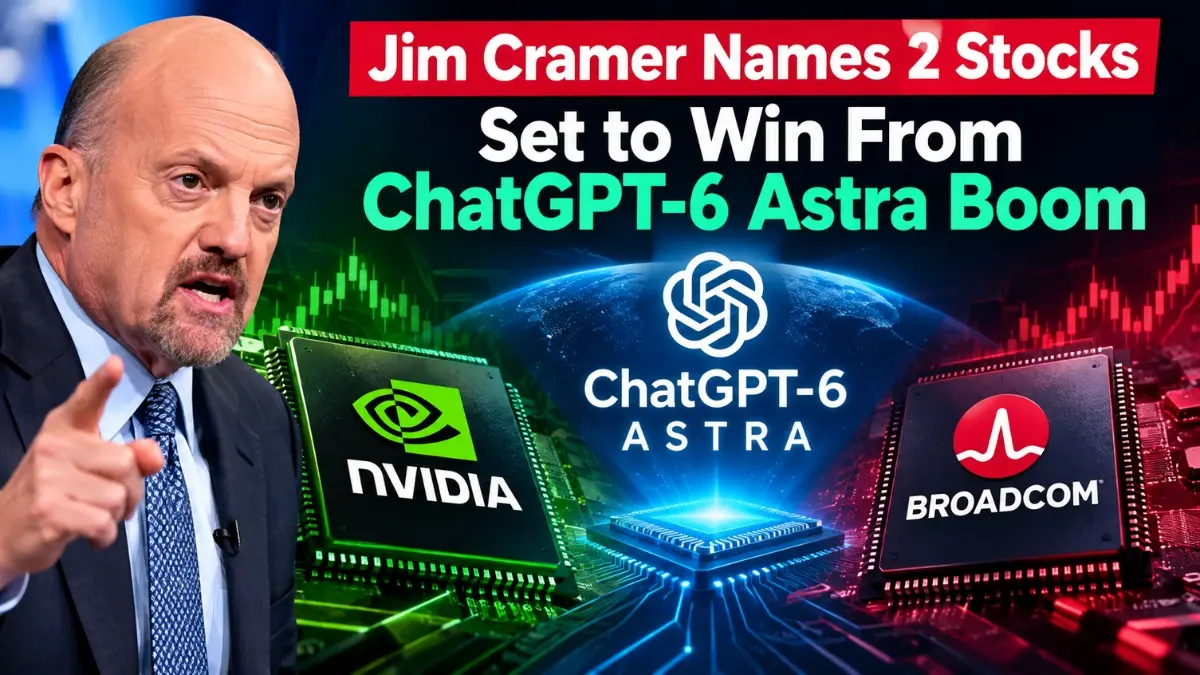
Jim Cramer Names 2 Stocks Set to Win From ChatGPT-6 Astra Boom
Cramer picked Nvidia and Broadcom on September 8, 2026, after OpenAI’s GPT-6 Astra launch. The compute figures behind the call are real: 100,000 Blackwell GPUs to train Astra, with a reported 400,000 more coming online for OpenAI. But the two picks sit on opposite sides of the same argument. Nvidia sells merchant GPUs for training. Broadcom co-designed a custom inference chip with OpenAI called Jalapeno. If custom silicon takes over inference, that is a headwind for Nvidia, not a tailwind. You can own both. You cannot be bullish on both for the same reason.
Key takeaways
- Cramer’s line on Nvidia: “The stock that I think you should be buying is Nvidia. It didn’t do anything wrong at all.”
- Astra’s training run reportedly used 100,000 Nvidia Blackwell GPUs, with roughly 400,000 additional GPUs coming online for OpenAI.
- Broadcom built a custom AI inference chip with OpenAI called Jalapeno. Anthropic is expected to be Broadcom’s largest custom silicon customer in fiscal 2027, with OpenAI second.
- Market reaction on September 8 went against the Nvidia call: NVDA opened higher then fell 2%, while AVGO rose 2.5%.
- Cramer’s charitable trust holds positions in both companies, which he disclosed.
What Cramer actually said
The framing was straightforward. OpenAI shipped GPT-6 Astra, the reception was strong, and Cramer argued the market was mispricing who benefits.
On Nvidia, his point was defensive as much as bullish. Nvidia had been sold off on worries about custom silicon eating into its share, and Cramer’s view was that Astra’s existence is proof the training demand is not going anywhere: the chipmaker “didn’t do anything wrong at all.”
On Broadcom, the argument was about validation. Broadcom co-developed Jalapeno with OpenAI specifically for inference workloads. A well-received flagship model means more inference volume, which means more Jalapeno. Cramer also tied this to the possibility of OpenAI and Anthropic IPOs, which would put a public market value on the customers underwriting Broadcom’s custom silicon backlog.
He disclosed that his charitable trust owns both. Worth noting, not disqualifying.
The compute numbers underneath
Strip out the commentary and the reported hardware figures are the substance of the call.
| Item | Reported figure |
| GPUs used to train GPT-6 Astra | 100,000 Nvidia Blackwell |
| Additional GPUs coming online for OpenAI | ~400,000 |
| Broadcom’s largest custom silicon client, FY2027 | Anthropic |
| Second largest, FY2027 | OpenAI |
Half a million Blackwell-class accelerators is a large number that gets thrown around without anyone doing the arithmetic. So here is rough arithmetic, with the assumptions stated because they carry most of the uncertainty.
Take a Blackwell-class GPU at somewhere around $30,000 to $40,000 in a rack-scale system. Five hundred thousand of them puts silicon spend in the region of $15 billion to $20 billion. Now add everything that makes a GPU useful: networking fabric, high bandwidth memory, power delivery, liquid cooling, the building. Data centre economics generally put total system cost at 1.5x to 2x the accelerator cost. That lands the full infrastructure bill somewhere in the $25 billion to $40 billion range.
These are estimates built on public price ranges, not disclosed figures. Treat the order of magnitude as the useful part and ignore the decimal places.
What the estimate is good for is scale calibration. That is one company’s build-out for one model family. Nvidia’s data centre revenue does not depend on OpenAI, but OpenAI alone represents a meaningful chunk of a year’s demand. When people ask whether AI capex is real, this is what real looks like.
The two picks are not the same bet
Here is the part the segment did not address, and it is the most important thing about the call.
Nvidia and Broadcom occupy different positions in the AI silicon stack, and their interests diverge over time.
Nvidia sells merchant GPUs. Anyone can buy them, they run any workload, and the moat is CUDA plus the fact that nothing else is as good at training frontier models. Training is where Nvidia is close to unassailable. Training runs are experimental, the software changes constantly, and flexibility beats efficiency.
Broadcom co-designs custom ASICs. A chip like Jalapeno is built for one customer’s specific workload. It is inflexible by design and much cheaper per unit of useful work as a result. Custom silicon makes sense exactly where the workload is stable and enormous, which describes inference and does not describe training.
Now follow the money. Training a frontier model is a one-off cost measured in months. Serving it is a permanent cost that scales with every user, every query, every agent call, forever. Over any multi-year horizon, inference compute dwarfs training compute. That is not controversial; it is arithmetic on usage growth.
So the structural question for the sector is what fraction of inference runs on merchant GPUs versus custom silicon. Every point of share that moves toward Jalapeno-class chips is a point that does not go to Nvidia.
Cramer’s two picks are both correct in the short term, because the pie is growing fast enough that everyone eats. They pull in opposite directions on a five-year view. Owning both is a reasonable hedge. Presenting them as one thesis is not.
Also read: OpenAI Says It Solved Math’s Deepest Problem, But Mathematicians Say AI Stole Their Work
Jalapeno is the more interesting half of the call
If you only track one thing from this, track the custom silicon.
The detail that Anthropic will be Broadcom’s largest custom chip customer in fiscal 2027, with OpenAI second, is more informative than anything about GPU counts. It means custom inference silicon is not a single-customer experiment. Two of the leading labs are independently reaching the same conclusion about where their inference spend should go.
That is the pattern to watch, because it is how hardware transitions actually start. Not with an announcement that GPUs are finished, but with the biggest buyers quietly moving their most predictable workloads onto something cheaper, and leaving the experimental work on the flexible hardware.
Broadcom’s custom silicon business has a further characteristic that suits it to this: the design cycles are long and the customers are locked in for years once a chip taped out. Revenue there is visible far in advance in a way that merchant GPU sales are not.
The inverse Cramer problem
There is no polite way to skip this. Cramer has a public reputation for calls that go the other way, enough that “inverse Cramer” became a running market joke and at one point an actual ETF concept.
The fair version of the criticism is narrower than the meme. Cramer’s fundamental analysis on large-cap technology is usually reasonable. Where the calls go wrong is timing, because a stock recommendation delivered on television after a news catalyst has already moved is, by construction, a late entry. The information is in the price before the segment airs.
September 8 illustrated this within hours. NVDA opened higher and closed the move out down 2%. AVGO rose 2.5%. The Nvidia half of the call was contradicted by the tape the same day it was made.
That does not make the analysis wrong. It makes it a poor entry. Those are different failures, and conflating them is how people end up dismissing sound reasoning because of bad timing, or accepting bad reasoning because the timing happened to work.
Three names nobody mentioned
If the thesis is that Astra-scale models drive a compute build-out, the beneficiaries extend well past the two chip designers.
High bandwidth memory. Every accelerator needs HBM, the supply is concentrated among a handful of manufacturers, and it has been the actual bottleneck on AI hardware more than once. Memory suppliers capture value whether the compute is merchant or custom, which makes them the cleaner exposure to the argument above.
Power and cooling. Half a million accelerators is a utility-scale electrical problem. Grid interconnection, transformers, and liquid cooling systems are physical constraints on how fast anyone can build. Companies in that supply chain have order books that are far more visible than chip demand.
Networking. Training at 100,000-GPU scale is bounded by interconnect as much as by compute. Broadcom actually has significant exposure here too, separate from its custom silicon business, which is a part of the Broadcom case Cramer did not use.
None of these are recommendations. They are the parts of the same supply chain that a two-stock television segment does not have time for.
What would prove this thesis wrong
Worth defining in advance, because a thesis you cannot falsify is not a thesis.
Funding tightening. This entire build-out is financed. A change in the cost of capital for the labs and the neoclouds hits capex before it hits anything else.
A pause in OpenAI’s build-out. If that 400,000 GPU figure gets revised down or stretched out, the demand assumption weakens immediately.
Inference efficiency improving faster than usage. Model distillation and better serving stacks reduce compute per query. If efficiency gains outrun demand growth, total inference compute can flatten even as usage climbs.
Custom silicon underdelivering. If Jalapeno-class chips prove hard to keep utilised as models change, the economics that justify them collapse and workloads move back to merchant GPUs.
The bottom of it
Cramer’s underlying observation is sound. A well-received frontier model means more compute demand, and the companies selling compute infrastructure benefit. The reported figures behind it, 100,000 GPUs for training and 400,000 more coming, are large enough to matter.
The part worth doing yourself is deciding which side of the training-versus-inference split you actually want exposure to, because the segment presented two opposing bets as one idea. Nvidia is the training bet. Broadcom is the inference bet. Over the next decade only one of those is the bigger market, and it is not the one getting the headlines.