GPU Prices May Be on the Rise Again, according to a Japanese Retailer but I Wouldn’t Resort to Panic Buying
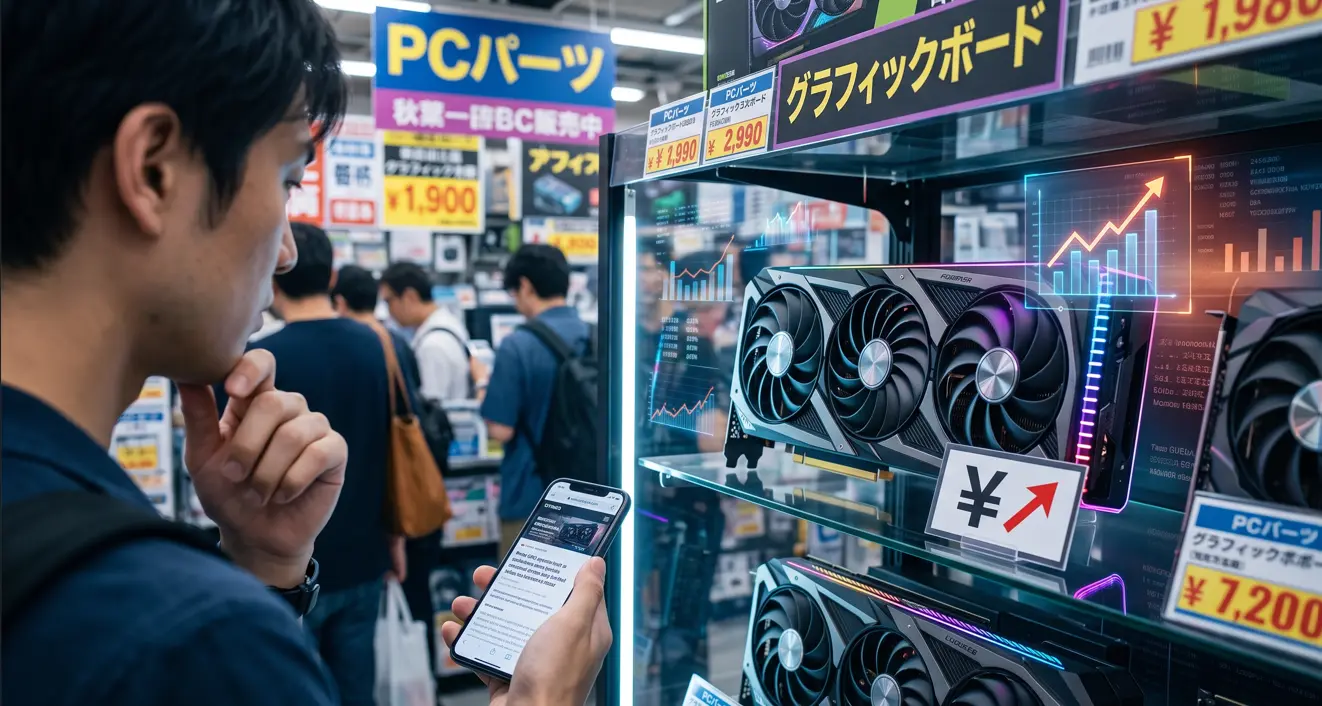
The warning is real. Japanese retailer Applied adjusted prices in August 2026 and told customers to buy soon, Akihabara shops have been running 20-30% above normal, and Tsukumo eX. is limiting customers to one card on anything from an RTX 5060 Ti 16GB or a Radeon RX 9000 series upward. But this is not a GPU shortage. It is a memory shortage wearing a GPU costume and understanding that changes what you should do about it. Panic buying is close to the worst available response.
Key takeaways
- Applied, a Japanese retailer, adjusted pricing in August 2026 and advised buying as soon as possible. Akihabara stores have been running roughly 20-30% above usual prices.
- Tsukumo eX. is rationing to one unit per customer on RTX 5060 Ti 16GB and above, or Radeon RX 9000 series and above. Cards with 8GB and up have become hard to restock.
- RAM module prices rose more than 246% during 2025 alone.
- The cause is AI data centre demand pulling memory fabrication capacity away from consumer graphics.
- Memory manufacturers are deliberately not expanding production, hedging against the possibility that AI demand is a bubble. That is the detail that determines how long this lasts.
- Cards frequently cited as overpriced include the RTX 5080, RTX 5060, Radeon RX 9070 XT and RX 9060 XT.
What the retailers are actually saying
The trigger for the current round of coverage is Applied, which adjusted pricing in August 2026 and told customers to buy as soon as possible.
Take that with appropriate context. A retailer telling you to buy now is a retailer doing its job. That does not make the warning false, and it does mean the source is not neutral.
The more informative signal is what Tsukumo eX. in Akihabara is doing, because rationing is a costly action a shop only takes when it genuinely cannot restock. The limit is one unit per customer on anything from an RTX 5060 Ti 16GB or a Radeon RX 9000 series upward, and the store’s own explanation was that cards with high-capacity memory have become very difficult to procure, with no idea when the next shipment arrives.
Notice how that limit is defined. Not by GPU model, not by performance tier, not by brand. By memory capacity.
That single detail tells you what this shortage actually is.
It is a memory shortage
Graphics cards carry VRAM, which is GDDR, which is a form of DRAM manufactured on the same fabrication capacity as system memory and, more to the point, as the high bandwidth memory that AI accelerators require.
RAM module prices rose more than 246% during 2025.
The mechanism is simple allocation. AI data centre demand is enormous and pays far more per wafer than consumer graphics does. When a memory manufacturer chooses what to produce, HBM for AI accelerators is the more profitable product, so capacity moves there. Chipmakers had also cut DRAM production during an earlier downturn, which tightened supply before the AI surge arrived.
The result: GPUs with more VRAM cost disproportionately more to build and become disproportionately harder to source. Which is why Tsukumo’s rationing threshold is drawn at a memory capacity rather than a performance level, and why 16GB cards are the ones vanishing.
If you want a single sentence to explain the last year of PC component pricing: the AI industry outbid you for memory.
Why this lasts longer than the last shortage
This is the part missing from most coverage, and it is the thing that should shape your decision.
The 2020 to 2022 GPU shortage was a demand shock. Cryptocurrency mining and pandemic buying created demand that outran supply, and it resolved when demand collapsed. Manufacturers had capacity; the problem was that too many people wanted the output.
This one is a supply allocation problem with a deliberate policy behind it.
Memory manufacturers are not expanding production capacity, and the reason is explicitly that they are hedging against the possibility that AI demand is a bubble. Memory is a famously brutal cycle. Fabs cost tens of billions and take years to build. Build into a peak and you spend the next cycle selling below cost, which has happened to this industry repeatedly and severely.
So the rational move, from a memory manufacturer’s position, is to enjoy the current prices and refuse to add capacity that could become an albatross.
That is capital discipline, not a physical constraint. And it means the shortage does not end when someone finishes a factory. It ends when the price signal changes enough to overcome the caution, or when AI demand slows and capacity gets reallocated back.
Neither of those is a fast process. Anyone planning around this easing in a few months is likely to be disappointed.
Also Read : Why Bitcoin Is Stuck Near $65,000 as AI Fuels Inflation
Why panic buying is the wrong move
You would be buying the top of a price move. Cards commonly named as poor value at current prices, including the RTX 5080, RTX 5060, Radeon RX 9070 XT and RX 9060 XT, are being bought at 20-30% above their normal pricing. You are not avoiding a future increase; you are locking in a current one.
You make it worse. Panic buying raises demand at exactly the moment supply is constrained, which pushes prices up further. Everyone rushing to beat the increase is what produces the increase.
Rationing already tells you the price will not clear the shortage. A shop limiting purchases to one per customer is a shop that cannot get stock at any price it can charge. That is not a market where being early helps.
There is one situation where buying now is defensible: you actually need a card now, for work or because your current one has failed, and the alternative is not having a working machine. That is not panic buying. That is buying something you need at a bad time, which happens.
What to do instead
Buy at a lower VRAM tier. The shortage is concentrated at 16GB and above. If your use case genuinely fits in 8GB or 12GB, you are shopping in a much healthier part of the market. Be honest about your actual requirement rather than the one you would like to have.
Look at the used market. This is where the current situation differs most usefully from previous shortages. A large installed base of previous-generation cards exists, and used pricing has not moved as sharply as new pricing. A used card two generations back at a fair price frequently beats a new card at a 30% markup.
Upgrade something else. If the goal is a machine that feels faster, a GPU is not always the constraint. Storage and CPU are worth checking first, though note that memory prices affect RAM and SSD pricing too, so this is not a completely clear route right now.
Lower the settings. Unglamorous, effective, and free. Most modern games at high rather than ultra settings look close to identical in motion and run substantially better on hardware you already own.
Consider a console or cloud gaming. Consoles are priced on a different model and have been less exposed to this. Cloud gaming has no hardware purchase at all. Neither suits everyone, and both are worth considering when the alternative is a 30% markup.
Wait, if you can. The most likely path is that this remains awkward for a while and then eases when memory allocation shifts. If your current setup works, waiting costs you nothing but patience.
What would signal the turn
Rather than tracking daily price posts, watch for these.
- Memory manufacturers announcing capacity expansion. The single clearest signal, and the one that would mean the capital discipline has broken.
- AI capex guidance coming down. If hyperscaler spending forecasts fall, memory allocation shifts back toward consumer parts within a couple of quarters.
- Rationing ending in Japan. Akihabara retailers have historically been an early indicator, since Japanese retail tends to reflect supply conditions faster than large Western chains.
- Contract DRAM prices falling. Published memory contract pricing leads retail GPU pricing by several months.
The honest position
Prices are rising, high-VRAM cards are hard to get, and rationing has started in at least one major market. That is all real, and the warning is not manufactured.
It is also not a reason to buy something you did not need at a price you would have refused a year ago. The cause is memory allocation and manufacturer caution, both of which resolve on a timescale measured in quarters rather than weeks, and neither of which gets better because you bought a graphics card today.
If your current GPU works, keep it. If it does not, buy the lowest VRAM tier that genuinely covers your needs, and check the used market first.
Any one of those matters more than another retailer warning about increases.