iPhone 18 Pro vs Foldable iPhone Ultra: Which Apple Phone Should You Wait For?
For most people, the iPhone 18 Pro. The Ultra costs roughly $900 more and ships without a telephoto camera and without Face ID, which are two of the three things people upgrade a Pro for. Buy the Ultra if a tablet-sized screen in your pocket is genuinely worth $900 to you and you accept a first-generation product. Buy the Pro if you want the best iPhone. Those are different questions and Apple has, for the first time, made them different phones.
Key takeaways
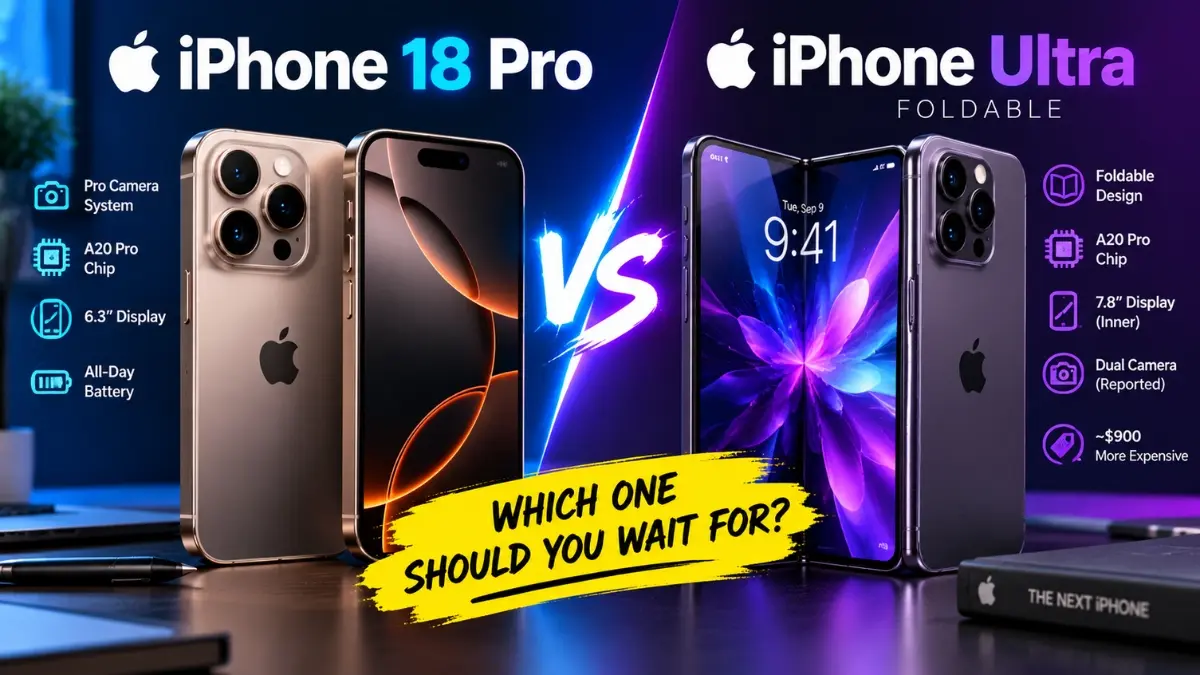
- iPhone Ultra: 5.5-inch outer display, 7.8-inch inner display with ProMotion, A20 Pro, 12GB RAM, Touch ID, 48MP wide plus 48MP ultra wide, no telephoto. Reported pricing $2,099 to $2,299, with high storage configurations above $3,000.
- iPhone 18 Pro: 6.3-inch display (6.9-inch on Pro Max), A20 Pro, 48MP main with variable aperture on Pro Max, improved telephoto, partial under-display Face ID. Expected around $1,199, with Pro Max near $1,299.
- Both use the same A20 Pro chip on TSMC’s 2nm process, so raw performance should be comparable.
- Announced September 9, 2026, with preorders expected around September 12 and availability around September 18.
- The Ultra is Apple’s first foldable. The 18 Pro is the eighteenth iteration of a mature product.
Side by side
| iPhone Ultra | iPhone 18 Pro / Pro Max | |
| Outer display | 5.5-inch OLED | 6.3-inch / 6.9-inch |
| Inner display | 7.8-inch OLED, ProMotion 120Hz | — |
| Chip | A20 Pro, 2nm | A20 Pro, 2nm |
| RAM | 12GB | Wider 96-bit LPDDR5x interface |
| Main camera | 48MP wide | 48MP with variable aperture (Pro Max) |
| Second camera | 48MP ultra wide | Ultra wide |
| Telephoto | None | Yes, improved low-light aperture |
| Front camera | 24MP | 24MP |
| Biometrics | Touch ID | Face ID, partly under-display |
| Storage | 256GB – 2TB | 256GB – 2TB |
| Modem | — | Apple C2 |
| Battery | — | 5,235–5,567 mAh (Pro Max) |
| Colours | — | Dark Cherry, Light Blue, Dark Gray, Silver |
| Price | $2,099 – $2,299+ | ~$1,199 / ~$1,299 |
Figures reflect pre-launch reporting and supply chain research, confirmed at Apple’s September 9 event.
The $900 question
Strip away everything else and the comparison reduces to one trade.
You pay roughly $900 more. You get a 7.8-inch screen that folds into your pocket. You give up the telephoto camera and Face ID.
That is the whole thing. Everything else is close to identical, because both phones run the same A20 Pro chip on the same 2nm process, both have a 24MP front camera, and both offer the same 256GB to 2TB storage range.
So the question is not which phone is better. It is whether a folding tablet screen is worth $900 and two features to you specifically.
For a small group, the answer is obviously yes. For most people it is obviously no. The interesting part is being honest about which group you are in before you preorder.
Where the Ultra wins
The screen, unambiguously. A 7.8-inch display with ProMotion is a different class of device to a 6.9-inch phone. Reading, documents, split-screen work, video, drawing, spreadsheets. Anything where screen area is the limiting factor gets substantially better, not marginally better.
Portability of that screen. A 7.8-inch tablet you can fold and put in a pocket has no equivalent. The alternative is carrying two devices.
The hinge, apparently. Reporting on people who handled prototypes consistently singles out the hinge as unusually solid, and the fold itself was not what testers complained about. For a first-generation foldable that is genuinely notable, given how much of the category’s early reputation was built on hinges failing.
Being first. If you want the first folding iPhone, there is exactly one product that is that, and no amount of spec analysis addresses it.
Also read: Apple’s Foldable iPhone Debuts Today: Will AAPL Stock Take Off?
Where the 18 Pro wins
The camera, and it is not close. The Ultra has no telephoto lens. The 18 Pro line has one, with an improved aperture for low light, and the Pro Max is expected to get a variable aperture on the 48MP main sensor.
Think about what that means in practice. Portraits at natural distance, anything at a concert or a sports match, any photograph where you cannot walk closer. On the Ultra those become digital crops from the wide sensor.
The most expensive iPhone Apple has ever made will take worse photos than one costing $900 less. That is a strange sentence, and it is the single biggest argument in this comparison.
There is a physics defence: a folded telephoto stack needs depth a folding chassis does not have. The defence explains the decision without changing the outcome.
Face ID versus Touch ID. The Ultra uses Touch ID, almost certainly because the Face ID sensor array has nowhere to live in a folding body. The 18 Pro keeps Face ID and moves some components under the display, shrinking the Dynamic Island.
Whether this matters is more personal than the camera. Face ID is better when your hands are wet or full. Touch ID is better with sunglasses, masks, or when the phone is flat on a desk. But at $2,099 you would expect not to have to choose.
Price. Nine hundred dollars is nine hundred dollars.
Maturity. The eighteenth generation of a product line has had every rough edge sanded down by hundreds of millions of users. Cases exist, screen protectors exist, repair shops know it, accessories fit, and every app has been tested on it.
The first-generation tax
Worth understanding what buying a gen-one Apple product usually costs you, based on the pattern.
Apple’s first-generation hardware is normally very well made. The original Apple Watch, the first AirPods, Vision Pro. The build quality is rarely the problem.
The problems are usually elsewhere. Software takes a couple of years to catch up to what the hardware can do. Third-party apps are not optimised at launch, and on a foldable that specifically means apps that do not use the larger screen properly or that reload when you unfold. Accessories are scarce and expensive. And version two typically fixes something meaningful about version one at the same price or less.
For the Ultra, the app situation is the one to think hardest about. Apple has reportedly redesigned app layouts for the larger internal screen, which helps for its own apps. Third-party developers have had far less time with real hardware. The Android foldable ecosystem, seven years in, still has apps that behave badly when unfolded. Apple’s App Store review process gives it more leverage to force compliance than Google has, so this may resolve faster. It will not resolve at launch.
The iPad arithmetic
Worth running before you commit $2,099, because it undermines the main case for the Ultra.
An iPhone 18 Pro at around $1,199 plus a mid-range iPad costs less than an iPhone Ultra, and gives you an 11-inch screen instead of a 7.8-inch one, plus a telephoto camera, plus Face ID.
What you lose is having the big screen with you at all times, and dealing with two devices.
That trade is the whole argument for the Ultra and it is worth being honest about how it usually goes. People who carry a bag most days often find the iPad-plus-Pro combination straightforwardly better and cheaper. People who do not carry a bag, and who currently do not have a large screen with them at all, are the ones for whom the Ultra solves a real problem.
If you already own an iPad and use it regularly, that is meaningful evidence about which group you are in.
Who should buy which
- Buy the iPhone Ultra if: you read, annotate, or work on documents on your phone for hours a week; you do not carry a bag and therefore never have a tablet with you; you rarely use telephoto; and $900 is not a decision you will think about again. Roughly, if the screen is the point of the phone for you.
- Buy the iPhone 18 Pro if: photography matters, particularly anything involving zoom; you want Face ID; you want the best value in the lineup. This is most people, and it will be the better phone for them by any ordinary measure.
- Buy the iPhone 18 Pro Max if: you want the biggest conventional screen and the best camera Apple makes, and the variable aperture on the main sensor is the feature that decides it.
- Wait if: you are curious about the foldable but not certain. The second generation will almost certainly add a telephoto camera or Face ID or both, and first-generation resale value on a new category is unpredictable. There is no penalty for letting other people test this one.
The honest framing
Apple has spent eighteen generations making one phone better. It has now made a second phone that is different rather than better, and priced it above the good one.
That is not a criticism. It is what a new category looks like, and the Ultra will get a telephoto camera and Face ID eventually, the way the Apple Watch got GPS and the AirPods got noise cancellation.
But right now, in September 2026, the iPhone 18 Pro is the better phone and the iPhone Ultra is the more interesting one. Work out which of those you are actually shopping for and the decision makes itself.