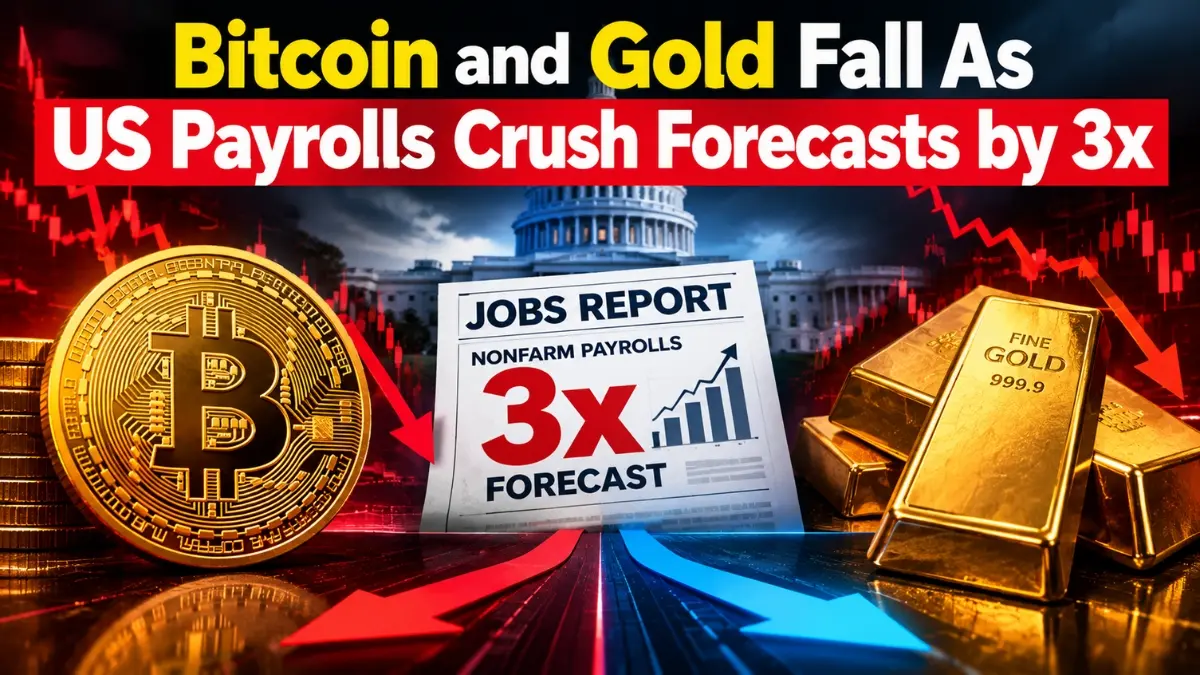
Bitcoin and Gold Fall As US Payrolls Crush Forecasts by 3x
August payrolls came in at 162,000 against a consensus near 56,000, roughly triple the estimate. Both gold and Bitcoin sold off within minutes because a hot labour market makes a September rate hike more likely, and both assets are priced off real yields. But they did not stay down together. Gold clawed back about half its loss by the close. Bitcoin sat near its lows. That divergence is the actual signal, and almost nobody wrote about it.
Key takeaways
- August nonfarm payrolls: 162,000 versus roughly 56,000 expected. Unemployment held at 4.1%. June and July were revised up by a combined 55,000.
- Odds of a September rate hike moved from about 55% to roughly 65% on the print.
- Gold fell 2.1% from $4,469 to $4,376, then recovered to around $4,419, closing down about 1.2%.
- Bitcoin dropped from above $82,000 to near $79,595, a 3.2% fall, and did not meaningfully bounce.
- Wage growth came in at 3.1% year over year, the slowest in several years. The market traded the jobs number and ignored the wage number.
- The Fed under Kevin Warsh is debating a hike, not a cut, with the funds rate at 3.50% to 3.75%.
The numbers
| Metric | Reading | Context |
| August payrolls | 162,000 | vs ~56,000 consensus |
| Unemployment rate | 4.1% | Unchanged |
| June + July revisions | +55,000 combined | Upward |
| Average hourly earnings | +0.3% m/m, +3.1% y/y | Slowest annual pace in years |
| 2-year Treasury | ~4.374% | 52-week high |
| 5-year Treasury | ~4.545% | 52-week high |
| 10-year Treasury | ~4.78% | — |
| Gold | $4,419 (-1.2%) | Off a $4,376 low |
| Bitcoin | ~$79,595 low | From above $82,000 |
| Sept hike odds | ~55% → ~65% | Post-print |
Why good news is bad news again
There is a version of this market most people still have in their heads where a strong jobs report is bullish. Companies hiring, consumers spending, earnings rising. That version does not apply right now, and the reason is worth being precise about.
The Fed’s funds rate sits at 3.50% to 3.75%. Kevin Warsh, in his first year as chair, used Jackson Hole in late August to call inflation concerning and to say the Fed has work to do. The July FOMC held rates in a 9-3 vote, with three members dissenting in favour of a quarter-point increase. Three dissents is unusual, and it told the market that the hawkish bloc was already at the door.
Into that setup, a labour market printing three times its expected job growth does one thing: it removes the last argument against hiking. If employment were deteriorating, the Fed could tolerate above-target inflation on the grounds that the economy needs support. At 162,000 jobs and 4.1% unemployment, that argument is gone.
Hence the move from roughly 55% to 65% on September hike odds, the two-year yield to a fresh 52-week high, and a stronger dollar. Every asset priced against real yields got repriced in the same minute.
Gold and Bitcoin fell together, then stopped
This is where the story gets interesting and where most coverage stopped writing.
The first fifteen minutes were identical. Gold dropped 2.1%, from $4,469 to $4,376. Bitcoin fell from above $82,000 toward $79,595, about 3.2%. Both behaved exactly like long-duration assets facing higher real rates, which is what they are.
Then they separated. Gold found buyers and recovered roughly half the move, finishing down about 1.2%. Bitcoin stayed near its lows for the rest of the session.
That is not noise. It is two different buyer bases showing up, or failing to.
Gold’s recovery bid comes from a place that has nothing to do with interest rates. There is an ongoing Iran conflict, disrupted supply chains around the Strait of Hormuz, and Brent crude near $95. In that environment gold has a permanent structural buyer: central banks and sovereign allocators who are not trading the payroll number and do not adjust on a 10-basis-point move in the two-year. When gold gets marked down on a macro print, that flow absorbs it.
Bitcoin has no equivalent. Its marginal buyer is leveraged, discretionary, and dollar-liquidity sensitive. When real yields rise and the dollar strengthens, that buyer steps away and there is nothing underneath. The lack of a recovery bounce is the tell.
The practical conclusion, and it runs against a decade of crypto marketing: gold and Bitcoin are not the same hedge. They correlate hard on the initial impulse of a macro shock, which is why they look similar on a chart, and then they diverge on the follow-through, which is where the money actually gets made or lost. If you own Bitcoin as a substitute for gold, this session was a live demonstration of what you are actually holding. It is a high-beta liquidity asset that happens to share a narrative with a reserve asset.
Also read: Bitcoin Whales Were Urging Friends to Buy Zcash Before Its Rally to $1,000
The half of the report nobody traded
Here is the part that got buried, and it may matter more in three weeks than anything above.
Average hourly earnings rose 0.3% on the month and 3.1% year over year. That is the slowest annual wage growth in several years.
Think about what those two data points say together. The economy added three times the expected number of jobs, and the price of labour barely moved. That is not an overheating labour market. An overheating labour market bids up wages, because employers compete for scarce workers. This one added workers without paying more for them, which is what a growing labour supply looks like, not a wage-price spiral.
For a central bank worried about inflation becoming self-reinforcing, wage growth is the variable that matters most. Goods prices can spike on a shipping lane closure and unwind when it reopens. Wages do not unwind. They are what turns a supply shock into persistent inflation.
At 3.1% and falling, wages are not doing that.
The market traded the headline jobs number in the first minute and never came back to the wage line. That is normal, because algorithms trade the headline, but it leaves an open question for the actual FOMC meeting: does a hawkish Fed hike into softening wage growth on the strength of a jobs count?
If the answer turns out to be no, the repricing that happened on payroll day reverses.
This is an energy problem wearing a monetary costume
Step back from the print and look at what is actually driving inflation in 2026.
WTI around $90, Brent around $95. Supply chain disruption around the Strait of Hormuz. An ongoing Iran conflict with the potential, according to some strategists, to push oil considerably higher if blockades persist. Silver at $67, gold at $4,400 plus.
None of that is demand-driven inflation, and none of it responds to interest rates. Raising the funds rate does not reopen a shipping lane or add a barrel of production. What it does is slow domestic activity in order to offset an imported price shock, which is a genuinely awful trade-off and the reason the July vote was 9-3 rather than unanimous.
The Fed’s problem is not really inflation. It is credibility. The Chase strategist quoted after Jackson Hole put it plainly: the July hold caused markets to question the Fed’s inflation-fighting resolve, and that “lowered the bar for a rate hike in September.” A hike in that context is partly a signalling exercise. That is a legitimate central banking motive, and it is also a much weaker foundation for a sustained tightening cycle than genuine demand-side overheating would be.
For anyone positioning across gold, Bitcoin and rates, this matters. Tightening driven by credibility tends to be shallow and to reverse quickly once the supply shock fades. Tightening driven by an overheating economy runs longer and hurts more.
What breaks this setup
Oil rolling over. If Strait of Hormuz tensions ease and crude falls back toward the $70s, the inflation impulse fades and the hawkish case dissolves within a couple of prints.
A soft CPI before the meeting. Warsh has already signalled discomfort. A cool inflation reading gives the doves cover and the hike odds fall back below 50%.
Payroll revisions. August’s beat was large enough to look like an outlier. Monthly payrolls get revised substantially and often. A downward revision next month reframes the entire narrative.
Something in credit. The two-year at 52-week highs stresses anything floating-rate and leveraged. Rate-driven accidents show up in credit markets first, and they end tightening cycles faster than any data release.
What to watch
Three things, in order of usefulness.
The next CPI print. This decides the September meeting more than payrolls did. Watch core services excluding housing, which is where the wage-to-inflation transmission actually shows up.
Whether gold holds $4,400. Gold’s recovery bid was the strongest signal of the session. If that bid keeps showing up on macro-driven dips, the structural buyer is intact and the geopolitical premium is durable. If gold breaks and stays below $4,400, that flow has stepped back and the whole complex has further to fall.
Bitcoin’s behaviour on the next dollar move. If Bitcoin keeps trading as a pure dollar-liquidity asset with no independent bid, then the correlation regime is settled and it should be sized like a high-beta risk asset rather than a hedge. That is a portfolio construction decision, not a trade.